


Water Hammer Analysis using BOSfluids
-
 19hr 30min
-
 Self paced
-
Trusted by professionals
-
Certification included
-
Industry standard content
Why take this course?
This BOSfluids course covers the full workflow for industrial water-hammer analysis, from pressure-surge physics and steady-state modeling to transient analysis and fluid-structure interaction. Software demonstrations and cases show how to build models, interpret results and compare mitigation options. This self-paced online course includes video lectures, worked examples and a completion certificate with PDH credits.

What you'll learn
After completing this course, you...
• have a solid understanding of water hammer phenomena,
• can perform water hammer analysis of basic scenarios in BOSfluids,
• know how to interpret pressure surge results,
• understand the influence of cavitation in piping systems,
• are familiar with the BOSfluids solvers,
• know how to link your results to pipe stress analysis software,
• have seen numerous real• life cases of water hammer phenomena in industrial piping,
• know different mitigation measures and their applicability,
• are capable of assessing pressure surge reports to take actions for mitigation of their system at hand.
-
 1-year access
-
 By Industry Experts
-
 100% Online Course
About the course
This course teaches you all the fundamentals of performing water hammer analysis using BOSfluids.
Background knowledge about water hammer phenomena and analyses methods are provided as well as tutorials in performing such analyses in the BOSfluids software. Results are discussed in detail to provide a solid understanding of their interpretation. Next to different water hammer scenarios and their analysis also many real-life cases are provided and associated mitigation measures are discussed.
After this course you are a confident user of BOSfluids that understands good design practices and analysis methods for water hammer phenomena in piping systems.
The course allows you to learn at your own pace and is fully provided online.
-
Self-Paced Course

-
19hr 30min
-
19.5 PDH Credits

-
English (Spanish Subtitles available)

-
SPC119

Meet your instructor
Dynaflow Research Group
Dynaflow Research Group is an engineering consultancy working across piping design and analysis, flow dynamics, vibration, FRP piping, pressure equipment and specialist engineering software. Its experience includes EN and ASME design rules for piping and pressure vessels, buried piping, water hammer, pulsation, dynamic stress assessment, vibration measurement, FEA tools, BOSfluids, BOSpulse, PV Elite and NozzlePRO workflows.
Who should attend this course
• Piping engineers performing water-hammer analyses• Process engineers responsible for transient-flow studies
• Pipe stress engineers using surge loads in structural models
• BOSfluids analysts building or reviewing models
• Technical reviewers assessing pressure-surge reports
• System engineers responsible for surge-mitigation decisions
Program & Details
-
Module 1 - Introduction to Pressure Surges

1. Introduction and agenda
2. What are pressure surges and what causes them?
3. Pressure surge examples: in industrial systems
4. Pressure surge analysis
5. Reducing the impact of pressure surges
6. Conclusions -
Module 2 - An Overview of BOSfluids
1. Introduction and agenda
2. General Workflow
3. Viewer
4. Overview of the element types
5. The components database
6. Import/export models
7. Exercise 1 - Modelling and simple analysis -
Module 3 - BOSfluids Live Demonstration
1. Interface & piping tabs
2. Viewer options
3. Add valve
4. The elements subtab
5. Boundary conditions
6. Analysis Setting
7. Reviewing the results
8. Managing scenarios
9. The updated results
10. Customized plots
11. Components database
12. Help windows & manual
13. Pipe editing options
14. The water hammer tutorial -
Steady-State Analysis in BOSfluids
1. Introduction and agenda
2. Steady state flow calculations
3. Boundary conditions
4. Flow resistance
5. Pumps in BOSfluids
6. Quasi steady analysis
7. Exercise 2 - steady state balancing -
Module 5 - Transient Flow Analysis
1. Introduction and agenda
2. Method Of Characteristics
3. Pressure wave propagation
4. Pressure wave tutorial
5. Exercise 3 - Pump trip
6. Exercise 4 - valve closure
7. What is cavitation
8. Cavitation models in BOSfluids
9. Flood & Drain analysis
10. Flood & Drain tutorial -
Module 6 - Fluid-Structure Interaction
1. Introduction and agenda
2. Unbalanced loads in piping systems
3. Setting up a structural analysis
4. Reviewing structural results -
Module 7 - Additional Features
1. Control systems tutorial
2. Tube rupture analysis tutorial
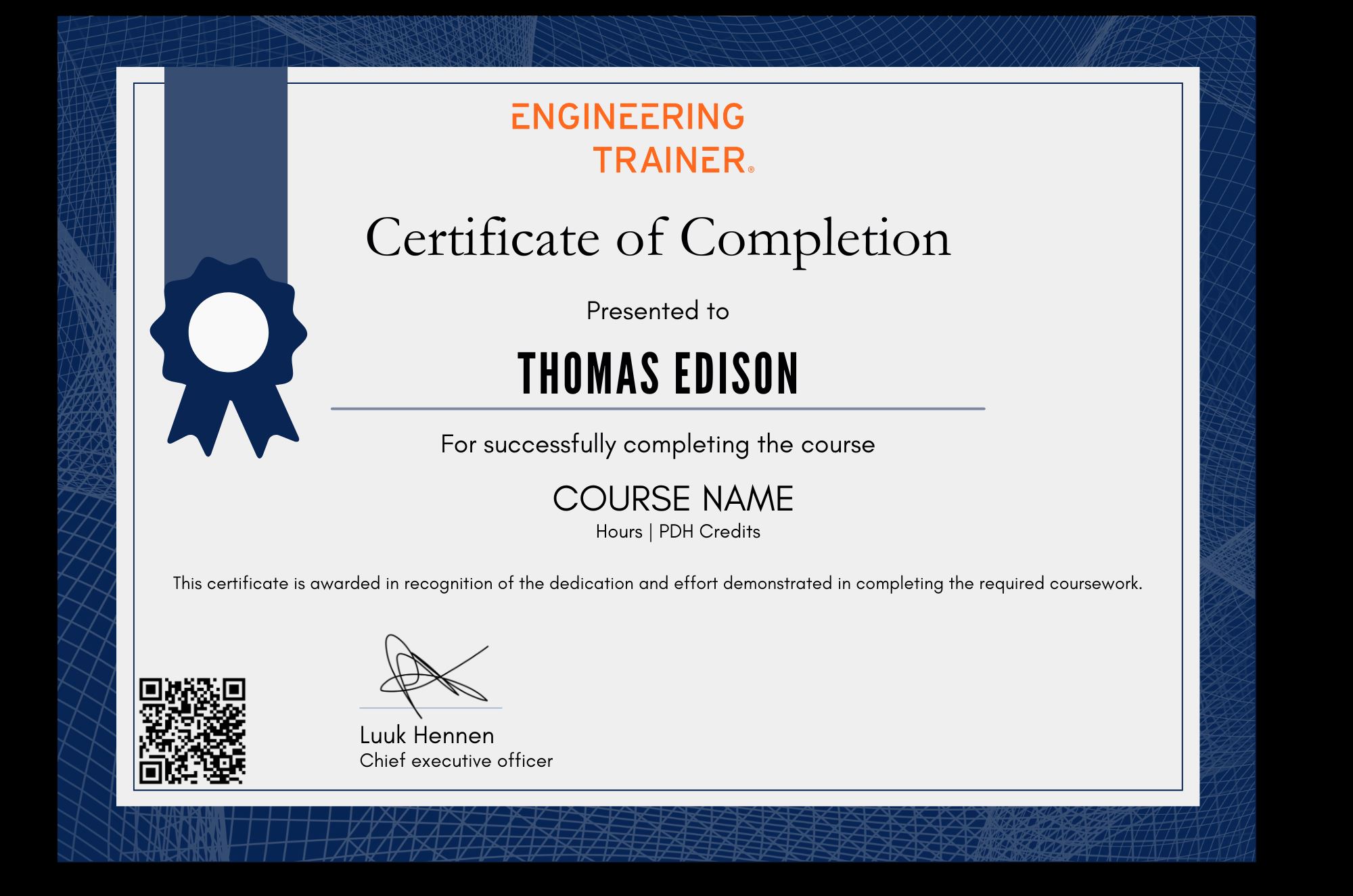
Certification
Related courses



Why choose EngineeringTrainer
-
Unlimited Team-wide Access
-
Advance Technical Competences
-
Courses by Industry Authorities
Since using EngineeringTrainer our internal mentorship has a much more matured character.
Logan Chapman - COO at Chapman Consulting Inc.
Request a Quote
Train Smarter. Grow Faster.
Build real-world skills that help you make better engineering decisions, reduce errors, and stand out in your field.